Maria’s (a pseudonym to protect the victim) nightmare began eleven months ago when an Uber driver rear-ended her car while she was waiting to park.
The Uber driver admitted fault at the time, saying it happened because he was looking the other way. He took out the car’s registration papers to fill out the accident report, but refused to provide his own information, claiming the car belonged to the company, despite having caused the accident. Maria had called emergency services immediately after the collision, and a patrol car from the local police in Pinto, where the incident occurred, responded to the scene.
The officers told the Uber driver he had to provide his information and sign the accident report, and the driver wrote next to his signature, “By order of the municipal police.”
Even at the time of the accident, Maria was experiencing back pain, so the police told her to go to the emergency room at a hospital immediately, which she did.
Since then, María has been going to doctors for severe pain; pain documented by doctors from the public healthcare system, HM Hospitals, Ruber, Quirón, La Milagrosa, and other medical centers. María went to rehabilitation and even a psychologist because she couldn’t bear everything she was going through, but despite all this, Reale Seguros refuses to compensate her. As one of the doctors who treated María told him when she explained what was happening: “But what incentive would we have to lie? Obviously, not all the doctors in the Community of Madrid can be wrong.”
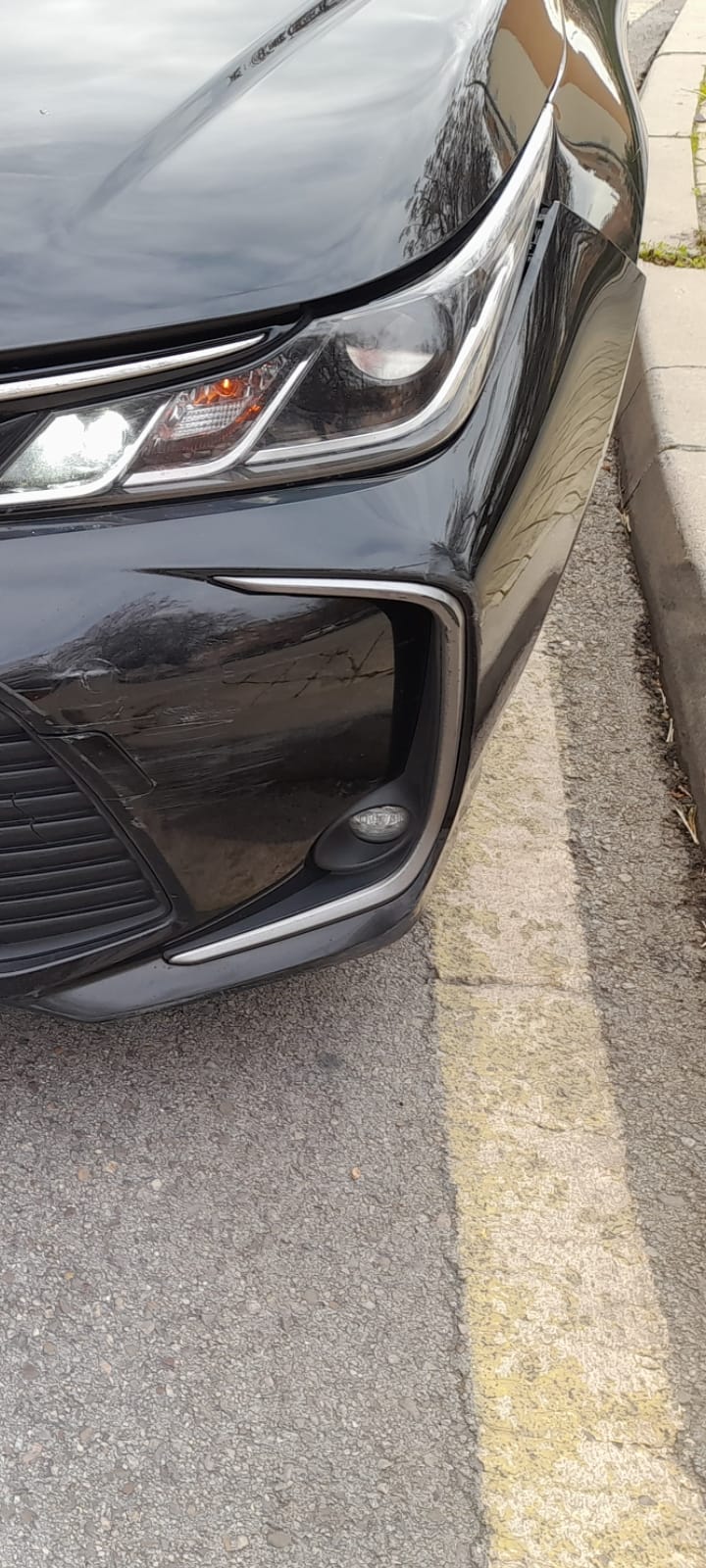
Back in March, before either María or her lawyers had even filed a claim with Reale Seguros, this company had already sent María’s insurance company a letter of refusal, declining to pay any compensation—something María only discovered many months later. Attached to the letter of refusal was a medical expert report, which on page two referred to “Mrs. Larios,” and María is not Mrs. Larios, proving that the doctor had used another patient’s template and changed a few details. They also attached a biomechanical report that was inaccurate, stating that the car that caused the accident was traveling at less than 16 km/h, which is impossible. I worked in insurance, and at speeds below that, you barely touch the other car, causing no damage to either the vehicle or the victim. Furthermore, look at the state of the front corner of the Uber and judge for yourselves if this can happen at less than 16 km/h, because María took this photo at the time of the accident.
Upon learning of all this, María contacted the communications director of Reale Seguros, who instructed her to send an email. Subsequently, the head of car insurance in Madrid contacted her and asked her to send any medical reports she had, which María did in good faith. María even emailed the CEO of Reale Seguros, Ignacio Mariscal, who told her he was traveling but would investigate the matter upon his return to Madrid. However, he never responded to her messages again.
The car insurance boss told her that in order to offer her anything, María had to see their doctor. When María received a call from the clinic and a text message scheduling an appointment, she searched online for information about the doctor and, seeing the negative reviews, feared the worst. She wrote to Reale Seguros and the clinic to say she hoped the doctor would treat her well, but received no response.
Imagining what might happen, María went into the consultation room with her phone’s recorder on, and the doctor immediately told her that he had received the email and that some of the reviews were true. Everything points to the doctor acting maliciously, as he wrote a report containing lies, something easily verifiable by comparing it with her own medical records. Reale Seguros refused to pay her any compensation, denying any causal link. Incidentally, even Maria’s insurance company paid for her medical expenses many months later, thus implicitly acknowledging the causal link, because otherwise they wouldn’t have paid for them.
In one of the phone conversations María had with the head of the auto claims department, she asked him, “What would you do if you, your wife, or your children had been in the accident?” To which the Reale Seguros representative replied, “Me? Sue.” Well, that’s exactly what María is going to do, because they’ve left her no other option, since Reale Seguros refused to settle amicably.
In that second letter of refusal that Reale Seguros sent to María, they attached the doctor’s report and another biomechanical report, which contradicted the first, but which also stated that the Uber car was traveling at less than 16 km/h, something that is clearly untrue. As María says, “It was going at least 30 km/h, because it didn’t brake until it hit my car.”
Maria filed a complaint against that doctor with the Ethics Committee of the Madrid Medical Association. In response, the doctor claimed he had never examined Maria, which is untrue, as evidenced by the recording Maria possesses, which is admissible in court since she was present during the conversation. This is further supported by the signed consent form the doctor had her sign in the office before the examination, as well as the text message the clinic sent her scheduling her appointment. Furthermore, the doctor claimed he had not prepared an expert report, but simply a medical report, which is also false, as Reale Seguros identifies him as a medical expert in their report. Therefore, in my opinion, as a journalist, this doctor’s report is entirely invalid.
Later, that doctor sent María a registered letter to her home after she had filed a complaint against him, something that could even be considered coercion, since the doctor has her address from medical reports, Reale Seguros, or the Medical Association, but he cannot use that address to harass a traffic accident victim in her own home. María didn’t accept the registered letter because, having also received a message from an individual claiming to be from the company that owned the car that caused the accident, threatening to release photos of her car and insulting her, she had to leave her house, leaving it with some friends. María informed Reale Seguros of everything that was happening, but received no response.
To make matters worse, Reale Seguros has that ride-hailing vehicle insured as a self-drive rental car, which they cannot do it. And apparently, it’s not the only ride-hailing vehicle that Reale Seguros has incorrectly insured in this way, as you can see in this news article published by our colleague at Infobae:
In the image, you can see the insurance policy of the Uber car that hit María, which incorrectly lists it as a self-drive rental car instead of a ride-hailing vehicle:

Maria hasn’t yet been discharged due to stabilization, because, as the doctor who monitors her every time she visits tells her, “How can I discharge you like this? It’s impossible.” Every time the doctor examines Maria on the examination table, she jumps from the pain caused by even the slightest touch. That same doctor told her back in the summer, “Start applying for disability benefits, because you’re going to need them.”
Maria applied for disability benefits months ago, but in Madrid, they’re taking between a year and a half and two years to process applications and they’re refusing to expedite the process.
Meanwhile, every time Maria goes out, she has to wear a Thermarcare lumbar support belt and take painkillers to manage the pain, and even then, it’s still painful.
María doesn’t care about anything anymore. She’s had to leave her home because of the threats she’s received, she lost her job because, just four days after going on sick leave for the traffic accident, she was unlawfully dismissed… During this time, she’s faced lawyers who only wanted her to be discharged quickly, despite her pain, so they could claim her compensation; doctors like the one from Reale Seguros who seem not to care about her pain; and insurance companies that only think about money, without caring about the suffering of traffic accident victims… But María is determined to take Reale Seguros to court because she has numerous medical reports that prove her pain as a result of the accident. Up until the day before the accident, she kept two exercise logs and worked on her feet most of the time without any pain. Now she can’t iron or do housework because she can’t stand for even two hours, she can’t work standing up, and she can’t sit for long periods either, because as the doctor tells her, “if you sit for too long you’ll ruin your back.”
Maria knows her life has changed and that her back will never be the same, but she’s also determined to fight for justice until the very end.
Maria also contacted Uber, but they refused to help her. She simply received a call to investigate what happened, but they wouldn’t give her the driver’s information from the app, because if he was on an active ride, they would also have to compensate her.
To all this, we must add that one of the largest ride-hailing fleets, in which Uber holds a 30% stake, is hiring drivers, requiring them to have no more than six points on their license… Do you realize the seriousness of this? You could get into a ride-hailing vehicle whose driver has already lost half their points due to various traffic violations. I can proudly say that I have never ridden in a ride-hailing vehicle and I never will.
Like other journalists, given the seriousness of what happened, I contacted Reale Seguros and Uber to request explanations, without receiving any responses. I even contacted executives at the Directorate General of Insurance, since they cannot allow Reale Seguros to continue having ride-hailing vehicles insured as self-drive rental vehicles without receiving a satisfactory answer.
